
For the week of Sept 28:
A month into this degree, I am beginning to realize the very obvious fact that books are objects which can never be fully understood. They are both products of an author’s individual mental apparatus (the wirings of which is constructed by personal and temporal history) and, filtered through that apparatus, reflections of an immensely intricate, dynamic human condition/society. Therefore, I’m beginning to run up against a problem which must plague all literature students: how much eludes me when reading a book. It forces me to conclude that one could, if they wanted, spend an entire lifetime studying a singular piece of literature, and it still wouldn’t be enough. (Indeed, I think many of my professors have done exactly that). These days, as soon as I finish a book, I feel compelled to immediately restart it because I feel like I didn’t “read closely enough”, and I’m frustrated that I’ve already forgotten key portions. But, that’s an impossible goal; one can never “read closely enough”. My mental capacity, the software I have for comprehension often feels weak, flimsy. I think the human brain would likely need to be able to perceive of whole other dimensions to fully understand any cultural artifact. I’ve often thought about the Divine in this capacity.
Sometimes I can feel the wide swathes of meaning that I’m missing, other times, I feel the stunted ability of my vocabulary to express my thoughts. My professors do not have this issue; what I admire about them most is their ability to precisely articulate their ideas. Thinking back to my ballet days, watching them speak is like watching a professional dancer plié or tendu. It seems so simple but years of training have shaped their muscles, creating a really specific, really beautiful kind of movement which can’t be replicated by anyone devoid of those decades of extensive practice.
I was chatting with a seventh year in the biomedical science PhD program, and we were discussing how graduate school imbues one with a sense of great academic humility. Undergrad (and everything before that) often felt to me like the goal was mastery; grad school is about discovery (or at least its pursuit). Now, in America (especially in the Humanities), thinking freely is a right that is unjustly threatening to become a privilege. While I sometimes hesitate at my (in)ability to think clearly, in this intellectual climate, I’ve become hyperaware of the importance of exercising my ability to read, to think, regardless of its quality. In this present moment, all I ask of myself is to try.
Books:
![Yekl and the Imported Bridegroom and Other Stories of the New York Ghetto [Book]](https://substackcdn.com/image/fetch/$s_!0wn-!,f_auto,q_auto:good,fl_progressive:steep/https%3A%2F%2Fsubstack-post-media.s3.amazonaws.com%2Fpublic%2Fimages%2Ff16ef8e5-9dbe-477e-9ca6-5b59643f0141_298x471.jpeg "Yekl and the Imported Bridegroom and Other Stories of the New York Ghetto [Book]")
A topic I know very little about, Yekl by Abraham Cahan (1896) tells the story of a Jewish immigrant couple fleeing Czarist Russia to New York City at the end of the nineteenth century. The husband immigrates first, pretends to exist as a single man, only to have his cover blown when his wife suddenly shows up with their son. In many respects, a typical immigrant story, but these are especially relevant in modern times.
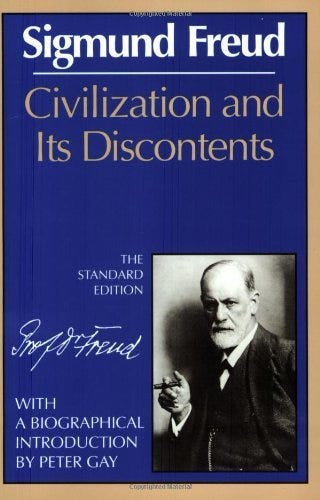
Civilization and Its Discontents (1930) is one of Freud’s greatest hits and with good reason. He starts off with asserting the radical idea that “only in the mind is such a preservation of all the earlier stages alongside the final form” (20). He then goes on to make the observation that if the pleasure principle is the guiding force of a human being, isn’t it odd that, within civilization, humans are asked to repress certain types/means of attaining pleasure? Chapter III discusses in great details how civilization has left us “discontent” , and I’ve found it interesting enough to recommend to friends. This discontent is somehow related to (results in? exists alongside?) a new term Freud calls the “death instinct” which is an innate desire to destroy that exists within the individual. This aggression constantly threatens to disintegrate society. Within the individual, Freud resolves this by suggesting that the death instinct, without a channel for external expression, turns inwards to create the “superego”, what we know as our conscience. The superego keeps us in line, keeps any violent impulses in check. This superego constantly surveils us, so we cannot hide even “bad” thoughts on which we have no intent to act. On a societal level, Freud resolves the death instinct by suggesting that there is a cultural superego which we know by the name of “ethics”. Ethics keeps the death instinct at bay, keeps us “polite”, keeps us “doing the right thing”, thereby ensuring society stays in tact.
As a side note, at the start of Chapter VI is the following line, which I find to be a hilariously accurate description of how it feels to write academically, describing the inevitable moment when you realize that your “amazing idea” for an essay is actually not very amazing at all:
“In none of my previous writing have I had so strong a feeling as now that what I am describing is common knowledge and that I am using up paper and ink and, in due course, the compositor’s and printer’s work and material in order to expound things which are, in fact, self-evident” (75)
Articles:
An Interpolity Legal Regime in the eighteenth century: procedural law of prize
Was assigned in the context of the Prize Papers archive, which is a collection of private possessions confiscated from various “enemy” boats during times of war in the 18th C. This article discusses the legal processes of maritime trade/warfare, particularly what was done to property confiscated on an enemy ship. These norms existed before there were formal notions of “international law” (treaties, etc.)
TV/Movies/Music:

Went to go see the album release in theaters with my new roommate. Disappointed but not surprised? The quality of her artistry is trending downwards. If I don’t think about it too hard, it’s pretty fun. The music playing on theater speakers was pretty awesome though.